A secret left in a public GitHub repository can become an Entra application sign-in within minutes. Microsoft Threat Intelligence observed agentic tools searching for exposed credentials and then using them to access customer cloud resources. In one case, an agent went from searching GitHub for client secrets to exfiltrating Azure Key Vault data in five minutes. The exposure reaches beyond the repository owner when a vendor-owned multitenant application credential opens access to downstream customer tenants.
Microsoft began seeing successful service-principal sign-ins from 199.19.77[.]84 as early as October 28. Its report describes sign-ins on dozens of associated applications across multiple tenants, followed by resource discovery, credential retrieval and access to Microsoft 365 data. A service principal is an application’s identity: possession of its valid credential lets a caller use the permissions granted to that application. Microsoft says, “Organizations that find their secrets exposed in public repositories must assume that the exposed secrets and associated applications are compromised.” For an organization with exposed application secrets or a connected vendor application, the immediate job is to identify the affected identity, its permissions and every tenant and resource it can reach.
A shared credential reaches customers
The agentic framework searched public code for secrets, then used valid credentials to obtain application tokens. Microsoft observed single-tenant OAuth applications used to enumerate cloud resources and, in some cases, exfiltrate Key Vault secrets. The report also describes a compromised vendor-owned multitenant application credential used against multiple downstream tenants. That is the harder scoping problem: a single credential held at the vendor can expose customers who never committed that credential to their own repositories.
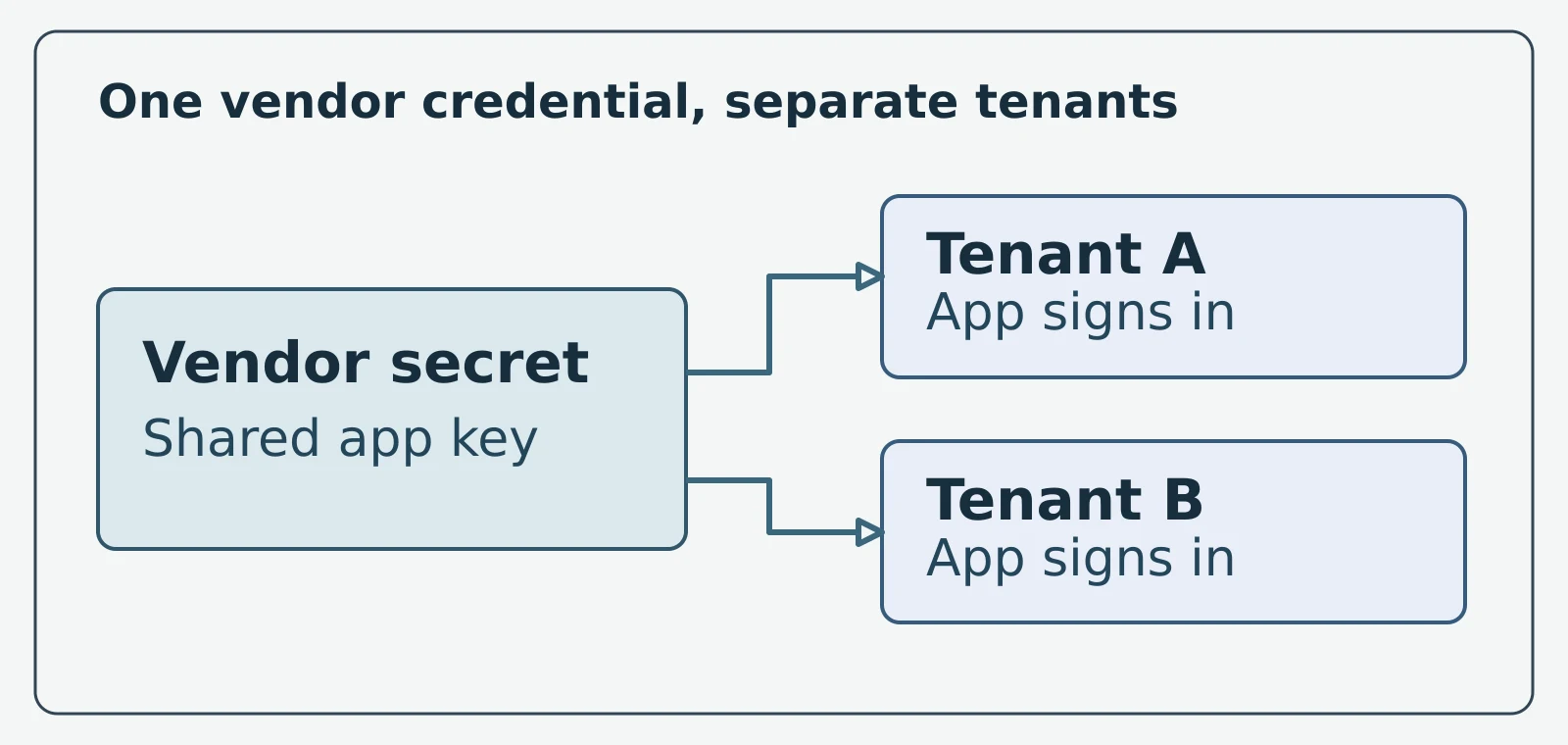
Figure details
A vendor-owned multitenant application credential on the left branches to two customer tenant boxes on the right. Each branch ends at a service-principal sign-in in its own tenant. The branches illustrate Microsoft's observation that a compromised vendor credential reached multiple downstream tenants; scope each customer tenant reached by the affected application.
Microsoft also saw agents seek storage account keys, App Service settings and publishing credentials, AI and machine-learning connections, and Azure Kubernetes Service user credentials. Compromised applications accessed SharePoint and OneDrive, including file downloads and mailbox-item access. The agents used Azure VM Run Command, which can execute scripts on a VM within the application’s authorized reach. Those are distinct places to look for subsequent access after the initial sign-in.
Failed requests became successful reads
Some Azure Resource Manager requests show how quickly the tool adjusted. A batch seeking Key Vault secret metadata used a data-plane API version against the ARM control plane and returned HTTP 400. About 28 seconds after the first failure, a rerun against the same vault paths used ARM API version 2023-07-01 and returned HTTP 200. Microsoft also describes similar failed-then-successful API-version changes for Azure SQL firewall rules and an Application Insights query endpoint. Correlate that status change with the same application identity and resource, then inspect sign-in and resource-operation logs for resulting access.
The source address 199.19.77[.]18 is a Tor exit node that Microsoft says may also carry unrelated activity. Microsoft separately observed malicious operations from 65.87.223[.]26, including attempts to obtain App Service authentication tokens, and reconnaissance from 157.22.126[.]128 against Azure AI workloads. Use these as investigation pivots, then correlate app IDs, tenant IDs, timestamps and resource operations. Agents can change their IP addresses and user agents.
Trace the application identity
Microsoft’s Entra documentation places service-principal and non-interactive sign-ins under Entra ID > Monitoring & health > Sign-in logs; the service-principal view ties identity, application and target resource together. Search from October 28 or as far back as retained records allow for 199.19.77[.]84 and 199.19.77[.]18, including failures. AADSTS7000215 (invalid secret) and AADSTS7000222 (expired secret) can mean someone holds an app credential; a failure followed by a successful sign-in for the same application calls for immediate triage. Look for one IP authenticating to three or more service principals with mixed results, or one application requesting tokens across ARM, Key Vault, Storage and Graph in a short period.
Join the sign-ins to Azure Activity, Key Vault and Storage diagnostics, Entra audit records, Azure DevOps auditing and Microsoft 365 unified audit records. Check secret reads, storage and document downloads, app permission changes, pipeline edits and Azure DevOps personal access token creation or first use. Turn on Azure DevOps auditing where it is off so subsequent changes become visible. Microsoft, a vendor reporting on activity in its own cloud and products, also lists Defender and Sentinel detections; inspect the underlying events to establish the scope of access.
Replace secrets and limit access
Find exposed application credentials in your repositories and other public repositories. GitHub’s secret-scanning documentation says scanning covers repository history and can alert on supported secret types; its public monitoring extends discovery beyond repositories the organization owns. Rotate or revoke every exposed credential immediately. Removing the line of code leaves copies in history and elsewhere. For an affected application, Microsoft recommends removing its client secrets, certificates and federated credentials, including additions by the actor, and disabling its service principal if needed. Rotate secrets in every Key Vault the app could read, plus credentials found in documents it accessed. Already issued tokens remain valid until expiry, so watch the identity and resources through that interval.
Microsoft recommends blocking 199.19.77[.]84/32 in a Conditional Access named location, directly assigned to workload service principals, and a user-scoped block policy for replayed sessions. Its workload-identity policy needs Workload ID Premium and covers only single-tenant applications registered in your tenant; the vendor-owned multitenant exposure therefore still requires credential and vendor coordination. For affected users, revoke Entra sessions, Azure DevOps PATs and SSH keys. If you manage customer tenants, review Partner Center access and GDAP relationships and notify affected customers under your agreements. Reduce future secret exposure by moving suitable applications to managed identities and narrowing service-principal permissions.
Verify each reachable resource
Revoke the exposed application credential and rotate secrets in each Key Vault the app could read. In Entra service-principal sign-in logs, check that the old credential fails new sign-ins and that the replacement identity has only its required permissions. Reconcile already issued token lifetime against Key Vault, Storage and document-access logs in every reachable tenant; investigate reads after exposure and any unexpected permissions. A clean repository commit is only the beginning: the response is complete when the identity has new credentials and least-privilege access, and each previously readable secret and affected tenant is accounted for.