Ethersphere Release Hack Exposes Bee Developers and Swarm Desktop Users
Malicious bee-js 13.3.0 and Swarm Desktop 0.56.2 shipped through genuine release jobs. Check install and launch history, then replace the affected artifacts.

An attacker used Ethersphere’s own release jobs to ship a remote-code loader in @ethersphere/bee-js 13.3.0 and Swarm Desktop 0.56.2 on November 9. Developers installing the npm dependency and users launching the desktop application had different entry points into the same attacker-controlled service. The Socket Research Team’s investigation found the loader ran three times inside the legitimate npm publishing job itself.
The bad npm version remained available for about 75 minutes. Swarm Desktop’s signed release stayed up for about eight and a half hours, and its update service could offer it to Apple Silicon Mac and Windows x64 clients. Ethersphere’s desktop release listing now names 0.56.3 as a replacement for the compromised 0.56.2; its bee-js release listing includes the earlier 13.2.0. A replaced release still calls for a check of machines that ran the old one.
Two releases, one loader
For the npm release, the actor changed package.json to ship scripts/generate-version.cjs and run it through postinstall. The altered script still generated version information, but first contacted api[.]frameworkmetrics[.]xyz at /v1/analytics. The desktop variant ran from dist/desktop/src/index.js inside app.asar as the Electron main process started, contacting the same host at /v1/electron before the app’s single-instance lock and updater. Both variants compiled and ran the server’s response with Node.js process privileges. The header X-Ethersphere with value 1 selected the real response rather than the decoy Socket received without it.
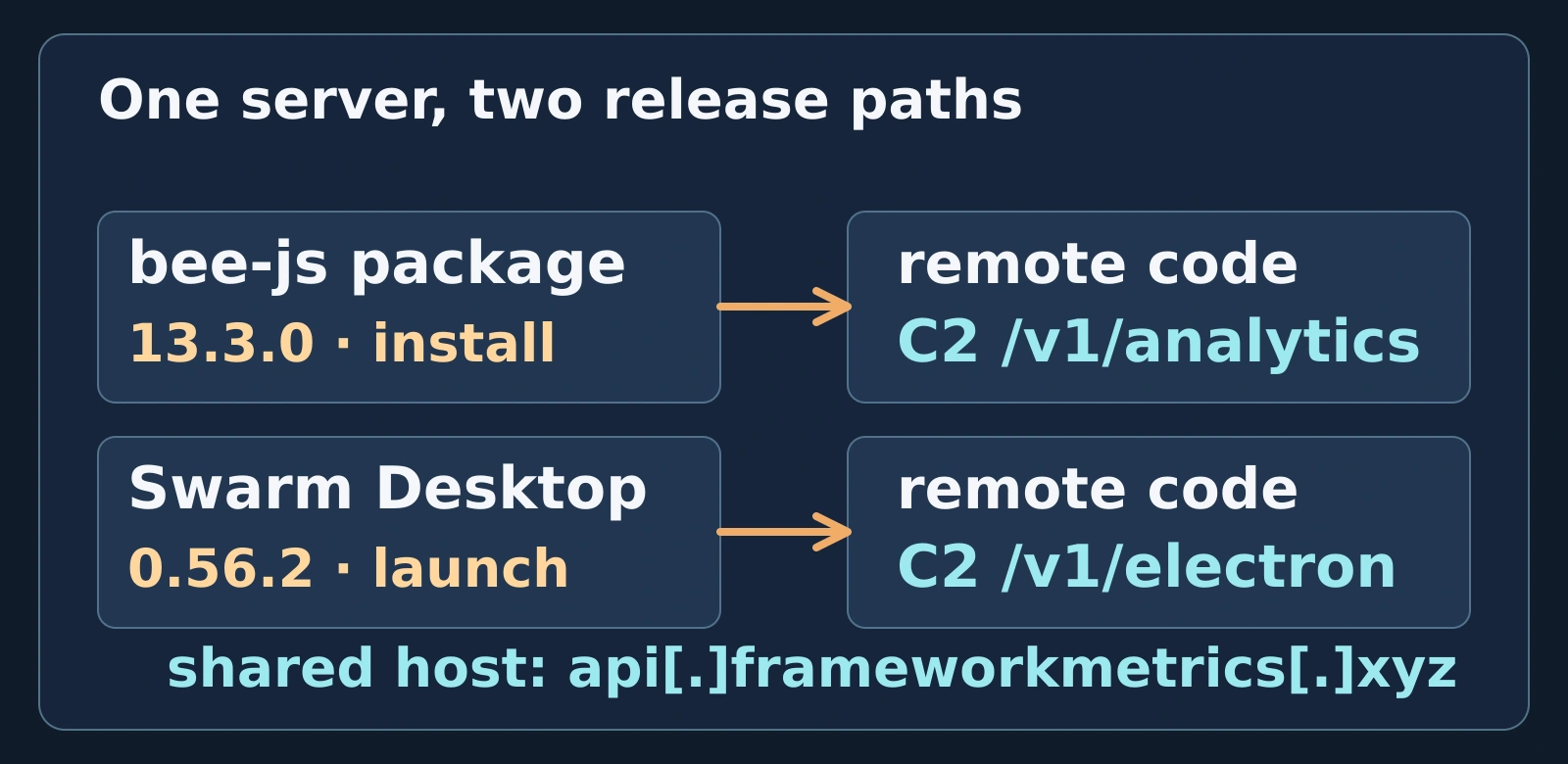
Figure details
The upper row points from a bee-js package install at version 13.3.0 to remote code at /v1/analytics. The lower row points from a Swarm Desktop launch at version 0.56.2 to remote code at /v1/electron. Both paths use the shared host api[.]frameworkmetrics[.]xyz. The separate triggers call for a dependency-install check and a desktop-launch check.
The npm package carried genuine SLSA provenance from Ethersphere’s trusted publishing workflow. Its published dist/ files matched the pre-release built from the parent commit; the added loader lived in the shipped script and install hook. Socket verified the attestation and found that the published build matched the tagged commit; the commit itself carried the loader. The macOS desktop build likewise carried the project’s real Developer ID signature and Apple notarization. These checks identify who built and signed the bytes. Here the attacker got malicious bytes into that build path.
Publishing job ran attacker code
The npm workflow accepted a release event while its test jobs were skipped, and its publishing environment had no required reviewer or tag policy. Socket found three runs of the altered version generator in the public job log. A line following each invocation read, “Generated src/version.ts from package.json engines”; shortly afterward the log printed “[FrameworkMetrics] analytics v2.3.1 is up to date,” a line Socket could not find in the package or repository. That is execution evidence for the publishing runner, not a count of compromised consumer hosts.
For the desktop release, an attacker-controlled branch fed a manually dispatched build workflow that held signing and notarization material. Socket unpacked nine release packages and found the same loader in each; it did not unpack an arm64 DMG from that CI job. The source change reached the Electron main process, so each launch of the affected app was a chance for the server to return code.
Socket traced later-stage code designed to find the Bee node’s config.yaml password and data-dir/keys/swarm.key keystore, post them to the same attacker service, and fetch an OS-specific implant. Its macOS and Linux samples used ~/.solidity/, the com.solidity.langsupport.runner LaunchAgent or solidity-langsupport-runner.service user unit; its Windows chain was built to install a hidden ScreenConnect client with service identifier 5cbe79c9c25524df and relay 185[.]232[.]84[.]169:8041. The shared Ethereum configuration contract 0xf8a900Db50b3331be6B768bA460BB59f3E40C344 links this infrastructure to the earlier SleepyDuck/EtherDuck extension campaign, according to Socket. Treat a fetched stage separately from an implant verified running on a particular machine.
Find installs and launches
Search dependency lockfiles, package-manager caches and internal mirrors for @ethersphere/bee-js 13.3.0; its npm integrity value is sha512-ltkrphoNy7TBIjCICDW7y3qa+j8yljt3+ohPRSM+id1rK2NaOgm5H5V/FioTQ0rEJ5IJ+Zj1micbAdQCqqc8iw==. The release was on npm from 00:09:50 to 01:24:58 UTC on November 9. Check install logs and runner jobs in that window, including transitive installs from Swarm tooling. With install scripts enabled, an attempted install that later failed could still have contacted the loader. Pin 13.2.0, clear cached 13.3.0 copies, and inspect exposed developer and CI credentials, including cloud access granted through runner OIDC trust.
On desktops, check the installed Swarm Desktop version and search bee-desktop.log for Bee Desktop version: 0.56.2 (production). Review DNS, proxy and endpoint records for api[.]frameworkmetrics[.]xyz; its two request paths distinguish the npm and desktop triggers. Socket counted 65 release-asset downloads by 08:27 UTC, including researcher traffic. Count your own installations and launches rather than treating download counters as affected machines.
Uninstall 0.56.2 and install the project’s 0.56.3 replacement; Linux packages need manual replacement. If 0.56.2 launched, preserve the host evidence and inspect for ~/.solidity/, the LaunchAgent or user unit, and the ScreenConnect service identifier. Rebuild affected hosts where the loader or implant ran. Move the Bee node wallet’s funds, chequebook and stake to a new key on a clean machine and rotate the node password. Removing the desktop application alone leaves a separately installed implant in place.
Put a review before publishing
For maintainers, require the publishing workflow to verify the release commit came from the protected branch or a merged release pull request, run tests on the release path, and put required reviewers and tag restrictions on the publish environment. Restrict manually dispatched signing jobs to reviewed refs. These checks sit before trusted publishing and signing, the point at which this attacker turned project authority into distribution.
Verify the package and desktop versions on endpoints and in CI caches after replacement, then match any 13.3.0 install or 0.56.2 launch to host and network evidence.