Elastic traces CyberStrikeAI server through four AWS accounts
Stolen identities fetched EC2 user data and secrets, then sent an SSM command. Correlate CloudTrail events by source IP across the 14-day return gap.

A CyberStrikeAI server used stolen AWS credentials across four accounts and eight identities over 16 days, Elastic Security Labs found. One EC2 role made 56 requests for instance user data in 141 milliseconds. After a 14-day gap, the same source IP returned to check credentials again. For teams protecting AWS accounts, the risk is a stolen instance role reading startup scripts and secrets while each individual API call looks ordinary.
Elastic identified the server by its CyberStrikeAI web interface and certificate, then tied its IP to CloudTrail activity. For triage, correlate the server and stolen credentials; an LLM decision-maker remains unverified. Investigate instance compromise and paths such as SSRF to trace how the role credentials left the hosts.
Fast reads, scattered identities
The server at 43[.]240[.]29[.]11 called GetCallerIdentity using IAM-user credentials in several accounts on September 30, 2026. Three calls across three accounts fell in the same second. An EC2 instance role Elastic calls app-role then accessed GetSecretValue and requested the userData attribute through DescribeInstanceAttribute. After an initial request, one assumed-role session made the 56-request burst. A further user-data request the next day brought the user-data retrieval alert count to 58. Those numbers describe API requests and alerts, not a count of distinct compromised instances.
EC2 user data is a startup script attached to an instance. If it holds bootstrap credentials, the ability to read it can expose another service. Elastic also saw a second instance role, nonprod-role, reading secrets. The aliases are Elastic’s replacements for the actual identity names; hunt by the real principal ARN and assumed-role session in your own CloudTrail events.
On October 2, container-role used GetParameter with decryption, then issued an SSM SendCommand 29 seconds later. CloudTrail records the SendCommand API call. Inspect SSM command history and the targeted instances to determine the document, command result and any changes.
Ten-minute rules meet a fortnight
Elastic’s six detection rules produced 78 alerts, all medium or low severity. The first day accounted for 65; the October 16 return generated three. Elastic wrote, “The source IP is what ties them together.” Its two newer high-severity detections flag more than 20 distinct instances whose user data one principal and source IP read in 10 minutes, or three or more distinct non-role identities calling GetCallerIdentity from the same external IP and ASN in 10 minutes. Those rules catch a burst; a durable case keyed to the source IP and identities connects it to later credential tests.
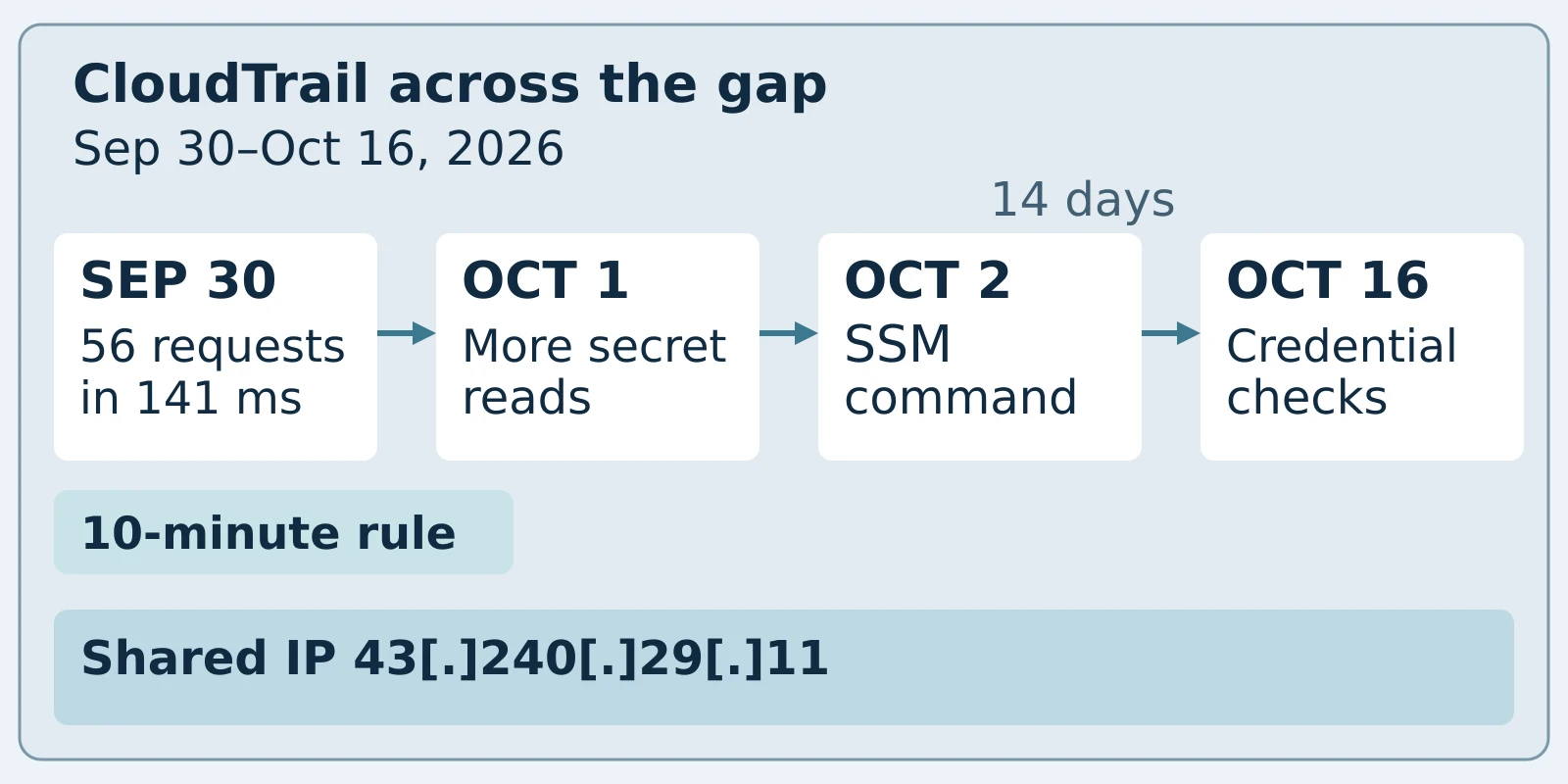
Figure details
Four equal cards move from September 30 through October 16. September 30 shows 56 EC2 user-data requests in 141 milliseconds, October 1 shows further secret reads, October 2 shows a `SendCommand` API call, and October 16 shows credential checks after a 14-day gap. A short ten-minute alert window covers the initial burst. A separate long span labeled with the shared source IP connects activity across the dates.
The IP is retrospective infrastructure evidence. Elastic also linked 43[.]240[.]29[.]28 and 43[.]240[.]29[.]33 to CyberStrikeAI interfaces with the same self-signed certificate, but observed AWS activity only from 43[.]240[.]29[.]11. The interfaces were seen on port 8080. The shared certificate serial is 3356730520974368630, and the reported FOFA service identifier is gOOpHYKNnstDLjmeRfUoIg==. The shared ECDSA public key for matching is:
45:FD:83:A2:38:2C:DD:70:2A:97:1D:E4:66:57:7D:E9:B0:EA:41:48:80:8A:B9:D1:63:95:90:C5:1E:A7:04:94:E3:21:7C:73:9F:EA:D2:29:3F:31:66:87:75:EC:BA:83:23:59:CA:4D:D9:7E:C2:9A:FC:FE:7D:28:5A:31:1C:67For each IP hit, compare the principal, session and API behavior before linking it to this intrusion.
Team Cymru’s earlier scan research counted 21 IPs running CyberStrikeAI between January 20 and February 26, 2026, in a different observation window.
Follow credentials beyond the burst
Start in CloudTrail event history or your organization trail and event data store. AWS makes 90 days of regional management-event history available by default; an organization trail or Lake store can carry records beyond that window according to its retention configuration. Search the three defanged IP values above as canonical IPs in your private tooling, then pivot on sourceIPAddress, userIdentity, assumed-role session, eventName and event time. For DescribeInstanceAttribute, narrow to userData requests; compare GetCallerIdentity, GetSessionToken, GetSecretValue, decrypted GetParameter and SendCommand against the roles’ usual source networks and approved workloads. Preserve the events and session context across the September 30–October 16 interval, including the quiet days between bursts.
Revoke access and verify recovery
For a matching principal, disable or rotate affected IAM-user access keys and revoke active sessions. Replace a compromised instance profile or instance to stop renewed role-credential issuance, and investigate how the instance credentials left the host. Rotate secrets accessible to the affected roles, including credentials in EC2 user data; move startup secrets into Secrets Manager or Parameter Store with tighter permissions. Limit ec2:DescribeInstanceAttribute access to userData for roles that need it. Review SSM command history for unexpected SendCommand use and check the targeted machines before restoring trust.
Verify the response against fresh CloudTrail and SSM records: the replacement identities should make only expected calls from approved source networks, retired credentials should stop producing successful events, and SSM command history should account for the October 2 activity. Keep hunting by principal and session when the server changes IP. The identity and its permissions connect the burst to the quiet days.