Cisco Revises Exploited Email Gateway SQL Injection Fix
The October 31 revision changes what AsyncOS 15.5 operators must verify: check Retro Remediation Engine 4.0.2 or later, then examine gateway and external logs.
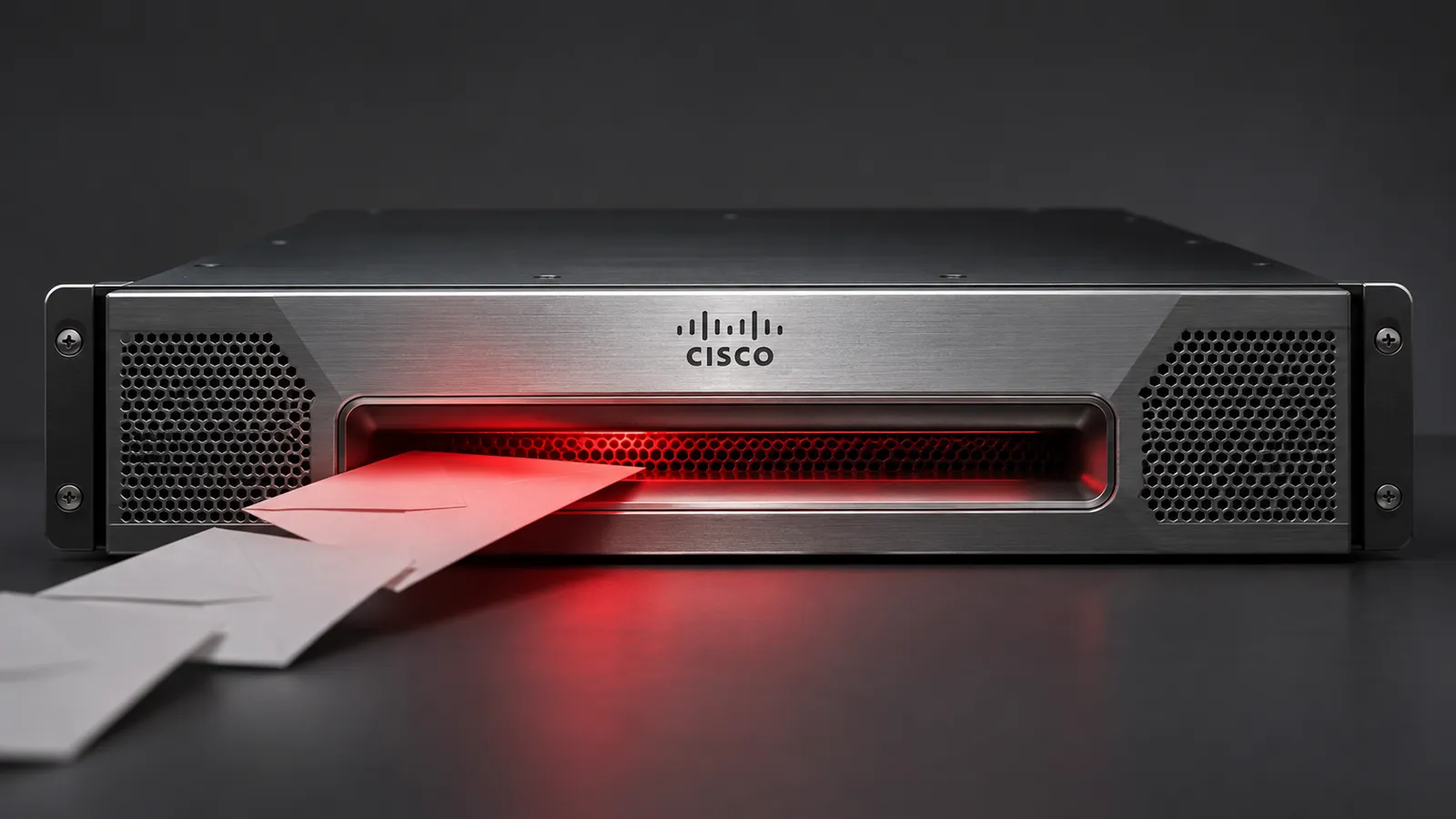
Cisco updated its Secure Email Gateway SQL injection advisory on November 3 after revising the AsyncOS 15.5.5-014 fix on October 31. If you run a physical or virtual gateway on the 15.5 branch, the installed release number is only part of the check: Cisco says the Retro Remediation Engine must also be at 4.0.2 or later. This is an actively exploited mail-parsing flaw, CVE-2026-76461, that can give an unauthenticated sender root command execution.
Cisco says it found malicious activity on some Cisco Secure Email Cloud devices and contacted the affected customers. Its advisory applies to physical and virtual Secure Email Gateways regardless of device configuration. Cisco has upgraded all Secure Email Cloud devices to 16.5.0-780; contacted cloud customers still have credential and cryptographic-material recovery work to do. On-premises operators need to check their own appliances and logs.
A message reaches the parser
The gateway processes mail from outside the organization. Cisco says insufficient validation in AsyncOS email parsing lets a crafted message carry malicious SQL statements through an affected device. Successful injection can execute SQL statements and then operating-system commands as root. The CVE Program record, assigned by Cisco, rates the vulnerability 9.8 on CVSS 3.1 and records Cisco’s report of active exploitation in September. Cisco says it found the flaw while resolving a TAC support case.
A crafted email reaches the mail parser even when management access is restricted. Restrict management access as Cisco recommends, and install the fixed AsyncOS release to stop this mail-parsing flaw. Cisco puts it plainly: “There are no workarounds that address this vulnerability.”
Mail logs and off-box traffic
For attempted exploitation, Cisco directs administrators to inspect mail_logs on each cluster member for suspicious SQL. Its non-exhaustive example is the case-insensitive pattern COPY.*TO PROGRAM in the IronPort Text Mail Logs. A match warrants investigation alongside the message and timestamp; the absence of that string alone cannot clear a gateway because a root-level attacker can remove local evidence. Cisco specifically recommends checking retained network and firewall logs outside the appliance for unexpected uploads from the gateway to external IP addresses or downloads from malicious IP addresses.
Cloud customers without CLI access may need Cisco’s direct notification and support to investigate. Cisco says it contacted Secure Email Cloud customers whose devices showed malicious activity. For on-premises clusters, preserve log copies and correlate each member’s mail_logs with off-box traffic before making recovery changes. Cisco warns that root access can expose the private SSH keys used between cluster members, so a compromised member puts its peers in the recovery scope.
Verify the revised fix
For AsyncOS 15.5 and earlier, Cisco lists 15.5.5-014 as the first fixed release. The October 31 update to that release responded to new information about exploit code available online. On an appliance running 15.5.5-014, run the defensive CLI command retroscannerstatus and read back Retro Remediation Engine version 4.0.2 or later to confirm the updated fix is installed. Cisco lists 16.0.4-302 for the 16.0 branch and 16.5.0-780 for 16.5; it strongly recommends moving releases earlier than 16.5 to 16.5.0-780. If the engine reports an older version on 15.5.5-014, install the revised fix before considering that gateway protected. Release 16.5.0-780 addresses this flaw regardless of the Retro Remediation Engine version.
Cisco’s broader September Secure Email hardening release covers several additional vulnerability classes and Secure Email and Web Manager. This SQL injection advisory concerns Secure Email Gateway specifically; Cisco confirms that Secure Email and Web Manager and Secure Web Appliance are unaffected by CVE-2026-76461. If you maintain both gateway and manager, use the applicable advisory and fixed-build table for each product.
Rebuild after suspected compromise
Where exploitation is suspected on a physical gateway, Cisco recommends contacting TAC and enabling remote access for its investigation. For a virtual gateway, preserve forensic information before replacing the VM because replacement destroys its local configuration and logs. Then deploy a new instance on a fixed release, rebuild the configuration, and renew credentials and cryptographic materials installed on the appliance. Restore every member of a cluster with a compromised appliance to a secure configuration; shared SSH keys may have been exposed. Cisco directs customers who cannot restore the appliance to TAC.
For a gateway without suspected compromise, install the appropriate fixed release and verify the installed build. On 15.5, read back the engine version as well. Keep external traffic logs long enough to investigate any earlier root-level activity. A successful version check addresses future exposure; suspicious mail or off-box traffic calls for incident response and the recovery steps above.